Germantown was laid out in 1834, renamed in 1836 and chartered in 1841. Its National Register sites, the train depot and the history center, with dates.
Last checked Oct. 17, 2026. History comes from the Germantown Historic Preservation Association, whose history the city also publishes on its Germantown History page; National Register listings come from the National Park Service’s National Register data. History center: 901-757-8480.
Germantown grew up on a ridge between the Wolf River and Nonconnah Creek, along the old Cherokee Trace, about 16 miles east of the Mississippi River. Its story runs from an 1820s frontier settlement through the Civil War and a World War I name change to a city of about 40,000.
Who to call
- Germantown Regional History and Genealogy Center: 7779 Poplar Pike, 901-757-8480
- Germantown Historic Preservation Association: germantowntnhistory.org
- City Historic Commission events: city communications, 901-757-7202
Timeline
- 1825 to 1830: Frances Wright, one of the area’s first settlers along with William Twyford, buys land in the area then called Pea Ridge and sets up Neshoba Plantation, a utopian community meant to prepare enslaved people for emancipation.
- 1833: A log schoolhouse is built; Baptists, Methodists and Presbyterians worship in it before they have churches of their own.
- 1834: Col. G.P. Shepherd lays out town lots.
- 1836: The community takes the name Germantown, for the German families living there.
- 1841: The town is chartered; the GHPA dates the charter of incorporation to Dec. 30, 1841.
- 1852: The Memphis and Charleston Railroad brings passenger and freight service.
- 1862: Germantown is sacked and burned July 23, according to the GHPA.
- 1863: Union troops build the redoubt now called Fort Germantown to guard the railroad.
- 1867 to 1878: Yellow fever epidemics, after the war, cut the population in half.
- May 15, 1917: Anti-German feeling in World War I leads to a new name, Neshoba.
- April 4, 1922: The name Germantown returns.
- 1947: A fire destroys the depot; Southern Railway rebuilds on the same foundation.
- 1959: The town becomes the City of Germantown.
- Late 20th century: The population grows from about 500 to just over 40,000.
National Register of Historic Places
The National Park Service lists these properties in Germantown:
| Property | Address | Listed |
|---|---|---|
| Germantown Baptist Church | 2216 Germantown Road | April 1, 1975 |
| Germantown Redoubt (Fort Germantown) | Honey Tree Drive, south of Poplar Pike | June 6, 1991 |
| Wildwood Farms (The Taylor Farm) | 2737 S. Germantown Road | NPS record dated July 24, 2017 |
| Oaklawn Garden | 7831 Poplar Pike | March 28, 2018 |
Germantown Baptist Church, at Germantown Road and North Street, traces its congregation to at least 1838, according to the GHPA. Its first sanctuary was built in December 1862 on land donated in 1841, served as a hospital for Union forces and was dismantled by Union soldiers.
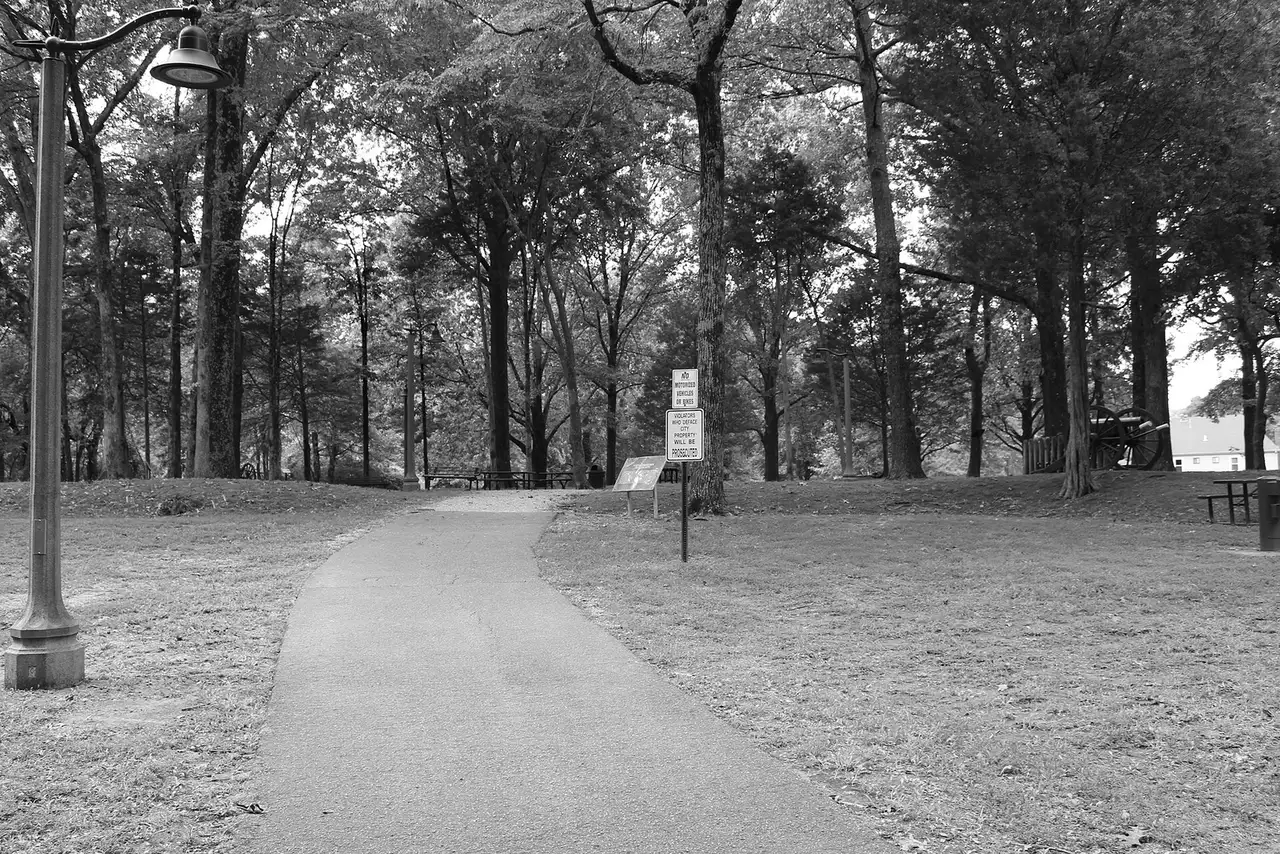
Fort Germantown is a square earthwork about 110 feet on each side with bastions at two corners, built in early 1863. University of Memphis archaeologists led by Dr. Gerald Smith researched the site and prepared its National Register nomination. The cannons there are reproduction 12-pound field howitzers. The five-acre park is at 3085 Honey Tree Drive.
Oaklawn Garden is now a city park and Germantown’s first level three arboretum, with more than 90 species of trees.
Places to visit
- Germantown Train Depot, 2260 West St. The railroad reached Germantown in 1852 and the first depot structure was built in 1858; today’s depot was rebuilt after a 1947 fire. The GHPA says it is open to visitors, and the city holds open houses, including 1 to 3 p.m. Saturday, Oct. 17, and Santa at the Depot, 1 to 4 p.m. Saturday, Dec. 19.
- John Gray House, Municipal Park, 1900 S. Germantown Road: the city calls it one of the oldest surviving brick residences in Shelby County, built before 1851. Germantown History Day is there from 1 to 3 p.m. Sunday, Oct. 25.
- Germantown Regional History and Genealogy Center, 7779 Poplar Pike: Mondays 10 a.m. to 2 p.m.; Tuesdays, Thursdays and Saturdays 10 a.m. to 4 p.m. The Tennessee Genealogical Society is next door.
- Fort Germantown Park, 3085 Honey Tree Drive, open dawn to dusk like other city parks.
- Markers and displays: the GHPA lists Civil War marker stops, photo markers along Germantown Road and Poplar Pike, displays at the Methodist hospital in Germantown, Bobby Lanier Farm Park and Oaklawn Garden, and an exhibit at the library every November.
- Germantown Cemetery: the GHPA’s cemeteries page has photos and history.
Related: parks and trails, Germantown population and growth and things to do this month.
Frequently asked questions
When was Germantown, TN founded?
Town lots were laid out in 1834, the name Germantown was adopted in 1836 and the town was chartered in 1841, according to the Germantown Historic Preservation Association. It became the City of Germantown in 1959.
Why was Germantown, TN renamed Neshoba?
Anti-German feeling during World War I led the Post Office Department to approve the name Neshoba on May 15, 1917. The town became Germantown again on April 4, 1922.
What is Fort Germantown?
A Union earthwork redoubt built in early 1863 to guard the Memphis and Charleston Railroad. Listed on the National Register of Historic Places in 1991 as the Germantown Redoubt, it is now Fort Germantown Park on Honey Tree Drive.
What places in Germantown are on the National Register of Historic Places?
The National Park Service lists the Germantown Baptist Church (1975), the Germantown Redoubt (1991), Wildwood Farms (record dated 2017) and Oaklawn Garden (2018).
Have your say